
Finding Lancaster Residents by Record
Lancaster sits inside Dallas County. Its record trail often starts outside city hall. An address can pull up a DCAD appraisal account, which then reveals a legal description and any recorded Dallas County instrument. A name works differently. You might test it against voter status, a court index, a probate file, or a historical directory, depending on the question. None of them lists everyone in a home.
Start with the sharpest fact you have. An address suits a parcel question, a full name plus a city or a relative suits a person, and a year suits an old household. Keep every account, document, or case number. Those identifiers make the next office search far safer than a broad name match.
- Search DCAD by owner, account, address, business name, or map and save the account detail.
- Compare the physical address, owner mailing address, legal description, and instrument reference before treating an owner as an occupant.
- Run the Dallas County Official Records index for the named party, legal description, or instrument number.
- Use VoteTexas or Dallas County Elections for a registration-status question, observing protected-address rules.
- For an earlier household, request the right directory volume or microfilm reel from the library or archives.
Keep that limit in view. Note: A record trail can pin down one narrow fact, but it cannot turn an owner, a voter, or an old directory entry into a complete list of a household.
Lancaster Resident Record Custodians
Dallas County offices supply most Lancaster records. Property, court, vital, and probate files all live there. The City of Lancaster adds municipal court, planning, code compliance, mapping, and library channels of its own. A portal is only one access route. The Clerk, DCAD, the elections office, library desks, archives, mail forms, and written requests still matter when a web search is incomplete or the record is older.
Dallas County Clerk Recording
500 Elm Street, Suite 2100
Dallas, TX 75202
214-653-7099
Dallas Central Appraisal District
2949 N Stemmons Freeway
Dallas, TX 75247
214-631-0910
The Lancaster street directory takes an address-first angle. It draws on the same custodians. But it starts from the street rather than the name. Send a city record request to the City Secretary. Or send it to the department that holds the record. County records go to the right Clerk division, not to Lancaster.
DCAD Searches for Lancaster Addresses
DCAD calls the account number its best key. A correct owner name or property address also locates an account. The address form splits number, direction, street name, building, suite, city, and an optional range. Street searches work best without Street, Drive, or Lane. A percent sign broadens a name. Typing %oak asks for street names containing oak, and the account card keeps the parcel's location separate from the address where the owner receives tax mail.
| DCAD field | Use in a Lancaster search | Important limit |
|---|---|---|
| Owner Name | Find a possible parcel owner | A name alone can match more than one person |
| Street Address and range | Inspect one parcel or a street segment | Street type is omitted from the search name |
| Account Number | Open the most precise appraisal record | It is an appraisal key, not a deed number |
| Map | Locate a parcel among nearby lots | Map geometry is not title proof |
The DCAD address search displays the address controls.
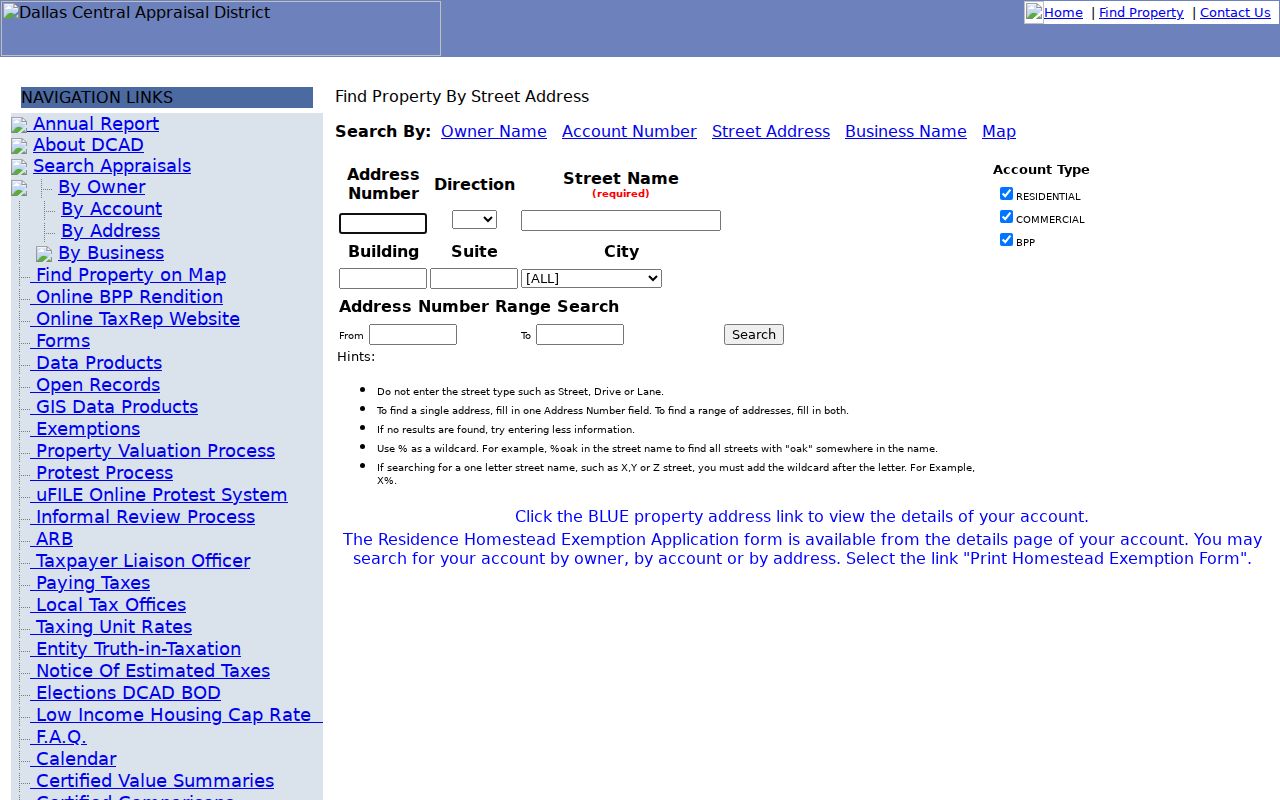
A DCAD result starts the trail. It never proves who lives there. Treat it as one lead for the Lancaster residents directory rather than a household roster. Note: A homestead exemption is narrow appraisal evidence, not a roster of the people in a home.
Current Lancaster Resident Directory Sources
Current sources overlap without duplicating one another. The Clerk's index lists people who signed or received recorded instruments. DCAD ties current ownership to a single parcel in Lancaster. The voter path handles registration status and polling details. City staff and association listings describe public contacts or neighborhood geography, not a private household roll. Match the record to the question.
| Record path | What it can establish | Lancaster keeper | Access channel |
|---|---|---|---|
| DCAD appraisal account | Parcel owner, situs, mailing address, legal description | DCAD | Free web account, phone, or focused open-records request |
| Voter registration | Status, jurisdiction, and public fields | Dallas County Elections / Texas SOS | Individual lookup; statutory list request for a broader file |
| Official records index | Recorded grantors, grantees, liens, plats, and instruments | Dallas County Clerk | Online index, counter, mail request, historical index |
| City staff directory | Public city employee contact | City of Lancaster | Online department and staff browse |
| HOA/PID maps | Association and neighborhood boundary names | City of Lancaster | Map and resource directory, not member lists |
A parcel card lays out current ownership, property location, owner mailing address, legal description, values, exemptions, history, and links to map and document tools. The DCAD account-detail format shows those fields. Read each one separately.
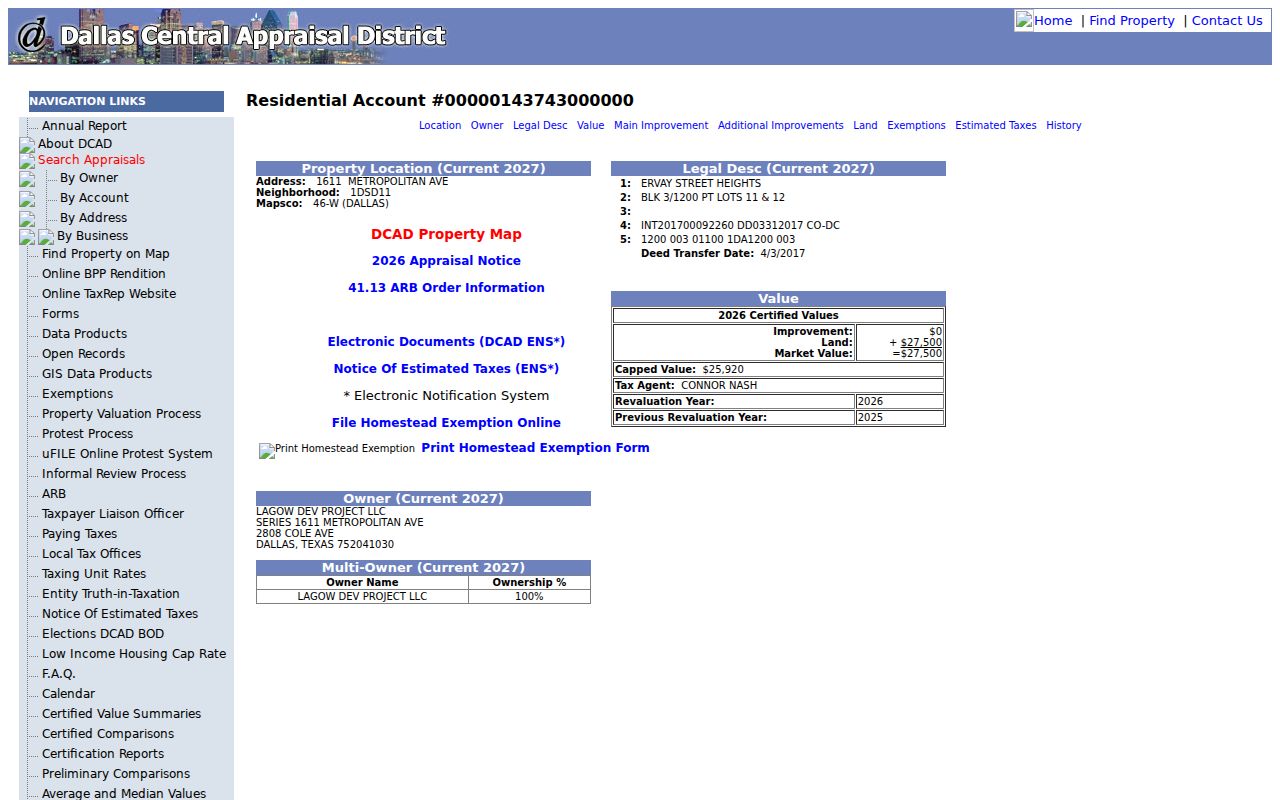
The parcel card makes a solid owner-and-property lead. Occupancy still needs its own record or word from the custodian.
Lancaster Voter Record Boundaries
Texas shaped its individual voter route for one job. It confirms registration and polling information, not addresses. Social Security numbers, Texas driver-license and DPS numbers, phone numbers, confidential addresses, and many dates of birth remain protected. A protected voter or an Address Confidentiality Program participant can even appear without a usable residence address. A no-result proves nothing. The person may still live in Lancaster.
VoteTexas links voters to the official registration route. Dallas County Elections runs its own registration lookup. A broader list request is a separate process under Texas Election Code chapter 18. It must follow the affidavit and use limits, and protected fields stay excluded. Registration marks a civic record at one point in time, but it never confirms every household member or ballot choice.
Dallas Deeds in a Lancaster Directory
The Dallas County Clerk's Official Records Search connects a Lancaster property trail to recorded instruments. Those include deeds, liens, releases, plats, and other filings. An instrument number is the best starting point. The current interface also accepts a recorded-date range. Quick and Advanced modes are available, and so is a choice between index-only and index-plus-full-text results. A two-word entry behaves differently across the modes. Note which search type produced a result. For older material, the historical QuickLink index offers Deed Record Index Books covering 1846 through 1963.
A grantor is the person transferring an interest. A grantee receives it. An index points to a document rather than replacing the document itself. The Clerk reports digitized real-estate records from 1846 to current. The search interface publishes no fixed online cutoff. Thin results call for the historical index. They also call for the counter, microfilm, or a mail request naming the property, instrument, and document type. The Dallas County Official Records search provides the current index. It also provides its date and search-mode controls.
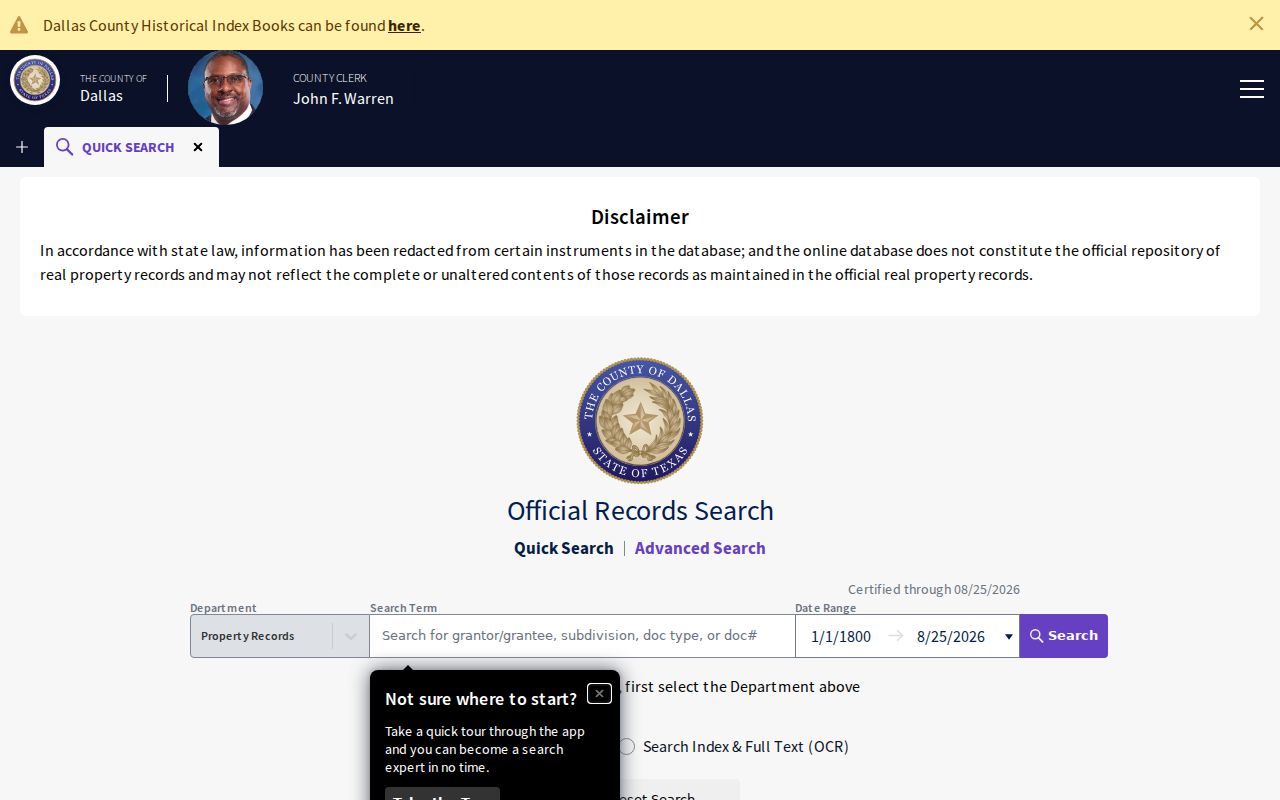
A deed chain lists grantors and grantees, so it can sketch who held an interest in a Lancaster parcel over time. It cannot tell you every resident who actually lived at the property.
Lancaster Names in Dallas Courts
Getting the right courthouse matters before searching a Lancaster name. Lancaster Municipal Court covers Class C and ordinance cases. It publishes no public name-search form. Dallas County’s case portal splits into civil district, family district, county and probate, felony, and misdemeanor tracks. Federal cases live in PACER. The statewide re:SearchTX service supplements participating civil courts rather than replacing any local system. Odyssey Smart Search takes a record number or a name typed Last, First Middle. Its tutorial also documents Advanced Search. That mode adds a Sounds Like option, hearing location and type filters, and date-range controls. A result may list a case number and parties. It may also show filing or hearing details, case type, and disposition. Sealed, juvenile, family, expunged, and similar sensitive records stay restricted. Remember, a docket is not a finding of guilt. Dallas County’s record-search directory sorts the court paths before a Lancaster resident lookup begins.
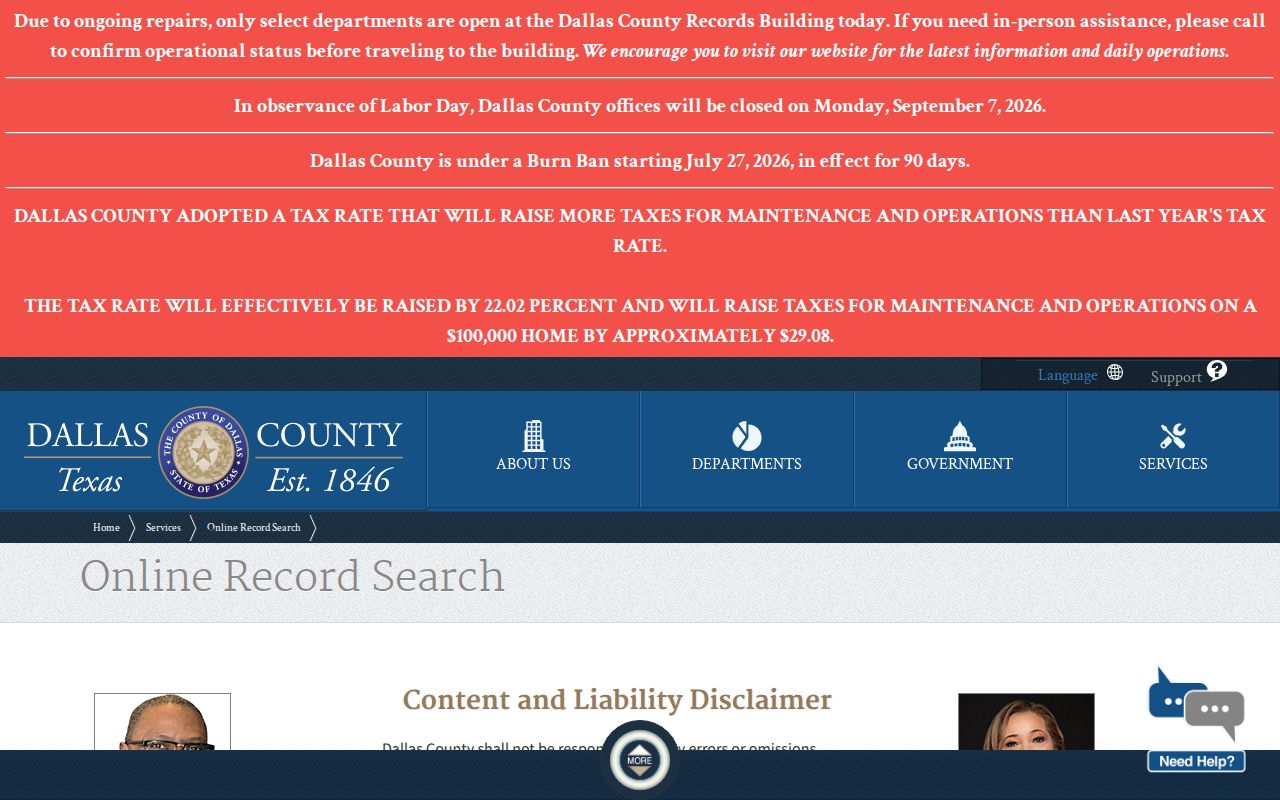
Before treating two similar Lancaster names as one person, compare the case number, division, and date. Then confirm with a second identifier.
Lancaster Vital Index Cross-Checks
The Dallas County Clerk serves as local registrar for Lancaster births, deaths, and marriages. Texas DSHS provides statewide certificates, verification letters, and marriage and divorce indexes. The marriage index starts in 1966. The divorce index starts in 1968. Each index can supply names, the event date and place, and file details. Yet neither is a certified license or decree. Older marriages and divorces require the proper county or district clerk. Under Texas Government Code section 552.115, birth records open after 75 years. Death records open after 25 years, subject to stated exceptions. Recent certificates carry qualified-person and immediate-family rules. DSHS forms spell out application, identification, mailing, online, and in-person channels. A verified index hit helps separate two people sharing a name. But the certificate or court record itself stays with its custodian. Texas DSHS Vital Applications and Forms lists the state forms. These cover birth, death, marriage, and divorce requests.
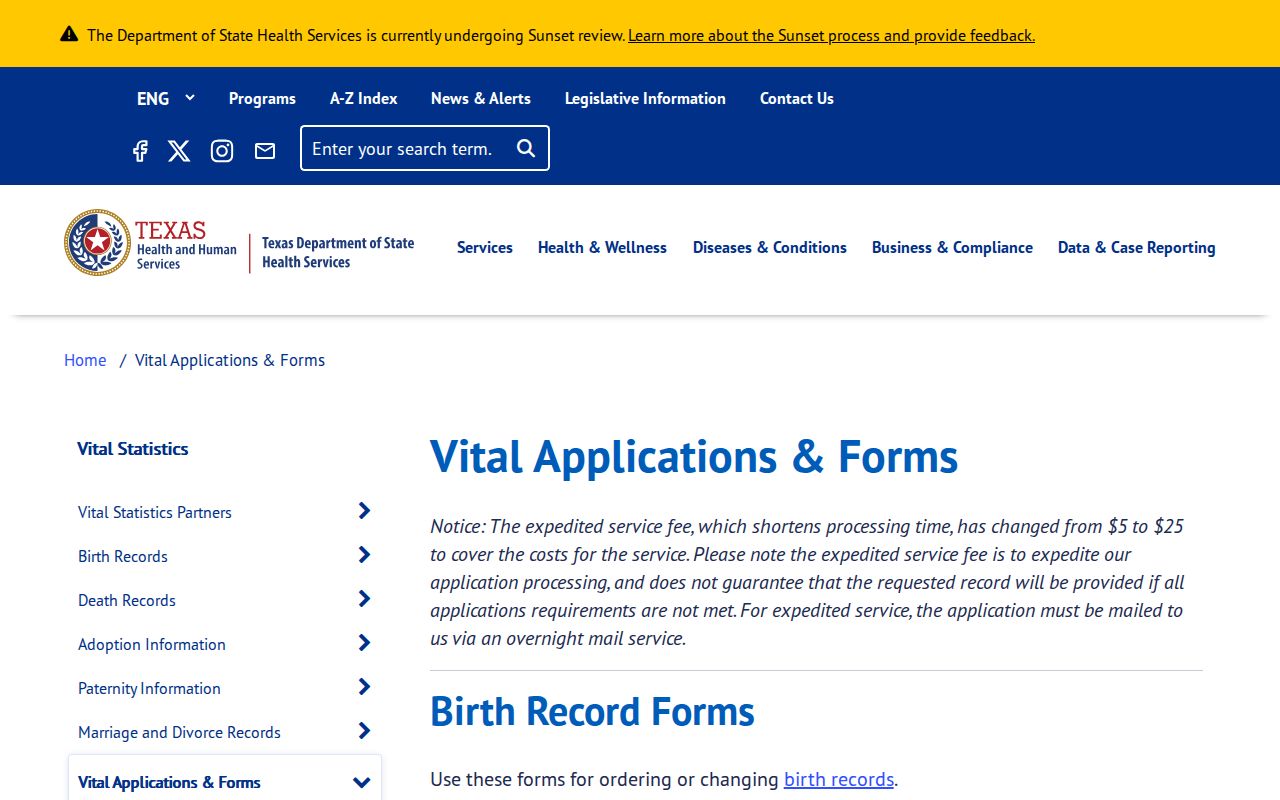
A historical index tells you a record exists. It does not hand you a certified copy. The form list helps you route an official request to the right county office instead of confusing an index line with the record itself.
Note: A marriage or divorce verification is not a certified copy of the county license or the district-court decree.
Historical Lancaster Resident Directories
Tracing a past household in the Lancaster residents directory usually leads to two shelves. One is the Dallas Public Library's Dallas History & Archives. The other is the state library, TSLAC. Dallas directories survive from 1875 through 1991, with gaps, print editions, and microfilm variants along the way. That run belongs to Dallas. It is not proof that every volume carries a separate Lancaster section. So ask staff for the exact volume or reel you need. Then work the alphabetical names, and the reverse or criss-cross sections where they exist.
City and telephone directories typically list a name, street address, phone, and spouse. Some add an occupation or an owner-renter mark. A reverse directory flips that. It starts with the address. Match the directory year against census, newspaper, deed, or probate records rather than making one entry carry a whole household. For the full collection route, see the Lancaster city directory collections.
Lancaster Library and Archive Trails
Lancaster Veterans Memorial Library is the local starting point. It offers reference help, public computers, scanning, and genealogy programming. The roots run deep. The Lancaster Genealogical Society formed there in 1977. Its Portal to Texas History partner summary lists 754 items across three collections. That summary names neither every title nor every year. Search the live collection by title, creator, and date. Do this before trusting any single item for a household history.
For the wider county story, the Dallas Public Library's History & Archives room holds directories, newspapers, maps, and Sanborn resources. Depository materials are part of the room as well. Upstairs on the 8th floor, the genealogy collection adds surname vertical files and family Bibles. Microform and database access are there too. These are physical fallbacks. A portal may show no image, no date range, or a record gap. The archives and the state library fill the hole.
Lancaster Deed-Fraud Record Checks
A deed naming your property deserves a fast, careful look. Dallas County runs a property-fraud alert program. You register a name. The county emails you after a document is filed under it. The notice is only notice. It cannot block a filing. It also cannot decide whether the filing is valid. A 2024 case brought the point home. The Dallas County District Attorney described a fraudulent-deed matter involving First Christian Church of Lancaster. That case shows why an alert, an index hit, and the underlying instrument matter differently. For Lancaster property owners, they are three different things.
An unfamiliar document in a search needs care. Save the instrument number and the filing date. Open the Clerk record and compare the legal description and the parties. If something looks wrong, contact the County Clerk and the appropriate law-enforcement or legal resource. Treat a mailing or a text message as proof of nothing. Treat an unsolicited offer to sell a copy the same way. For an official copy, the Clerk's mail-request form is the route, plain or certified. Use it whenever the online result does not answer the question.
Note: An email notification never cancels a recorded instrument, and a document title alone cannot explain a property transfer.
Lancaster Custody Gaps and Requests
Dallas County dates to 1846. Early courthouse fires damaged holdings. That history makes reconstructed books, microfilm, and later indexes vital for any Lancaster records search. A missing online image proves nothing. For a missing land record, the County Clerk mail form covers the gap. It asks for the recorded name, grantor or grantee, instrument number, document type, property address, and city. Plain copies run $1 per page. Certified copies add a $5 certification fee on top of the $1 per page.
Texas Public Information Act requests work best in writing. Address them to the body holding the records. Frame the request around one document or year. Texas Government Code chapter 552 requires prompt production, but it promises no record, no particular search result, and no ten-day release. The County Clerk has also posted temporary 2026 access changes, so confirm counter and email availability before you travel. The Dallas County Jail Lookup shows another narrow official index, one that searches current bookings by name, booking number, or case number rather than serving as a Lancaster residents directory.
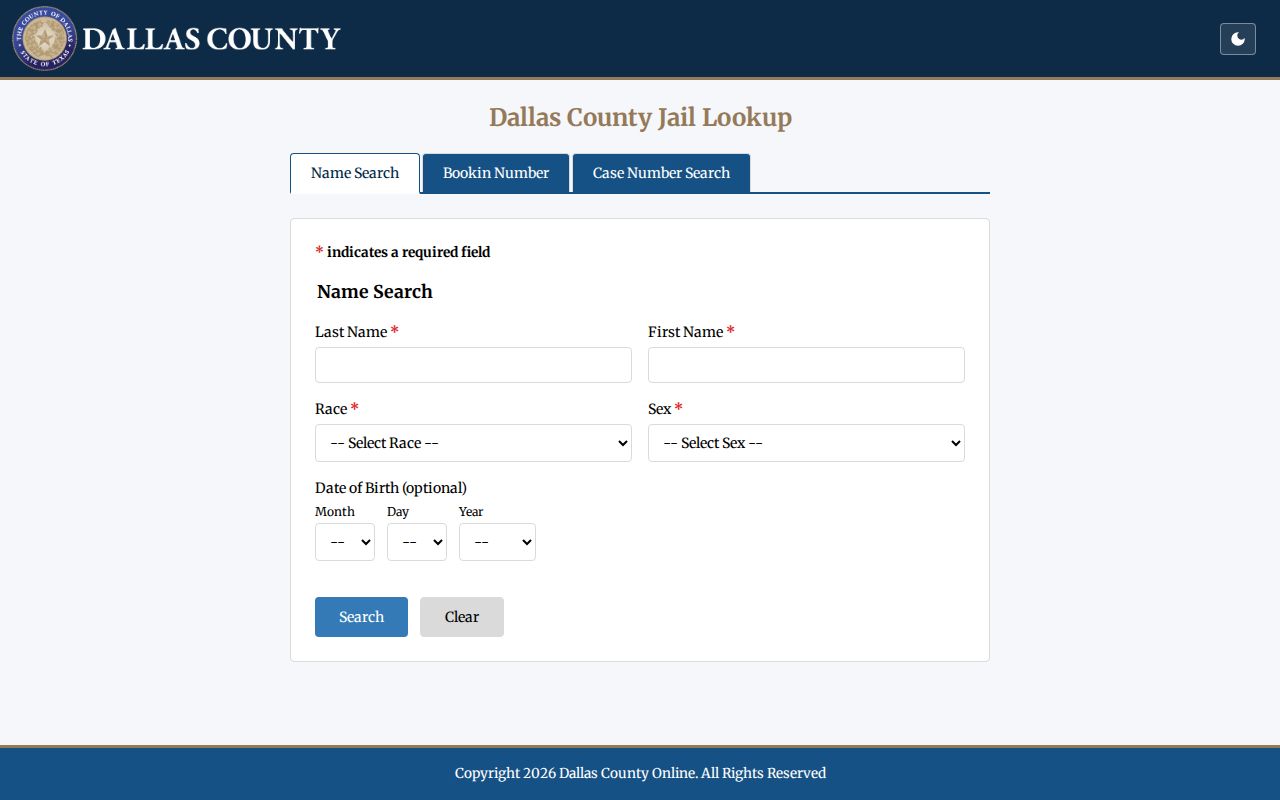
A custody result answers only the custody question on paper. For a changing status, verify with the Sheriff or the court handling the matter.
Reading a Lancaster Record Trail
Each source plays one role. A parcel is land identified by an appraisal account and legal description. A recorded index points to deeds and filings. A criss-cross directory is an address-first historical directory. The three can line up. Dates and purposes differ, though, so a current owner's tax mailing address may sit elsewhere, and a directory address may instead mark a business or a date-specific household clue.
| Parcel | A numbered appraisal account tied to property, not a person roster. |
|---|---|
| Index | A search tool that points to a record; obtain the image or certified copy when needed. |
| Criss-cross directory | An address-first volume that may name an earlier occupant or business. |
| Situs address | The physical property location, distinct from an owner’s mailing address. |
These distinctions carry real weight. They help with family history, estate questions, reconnecting with people who choose to be found, and checking an official record. They also keep a record trail honest.